Starting a business requires more than a good idea. You also need money to develop your product, reach customers, manage operations, and grow your company. However, not every founder has access to investors or large amounts of capital. This is where understanding bootstrapping vs funding becomes important.
Some entrepreneurs prefer to build their businesses using personal savings and business revenue. Others choose external investment to grow faster and enter new markets. Both approaches have advantages and challenges.
In this guide, we will explain the difference between bootstrapping and funding, explore popular startup funding options, and help you decide which approach may work best for your business.
What Is Bootstrapping in a Startup?
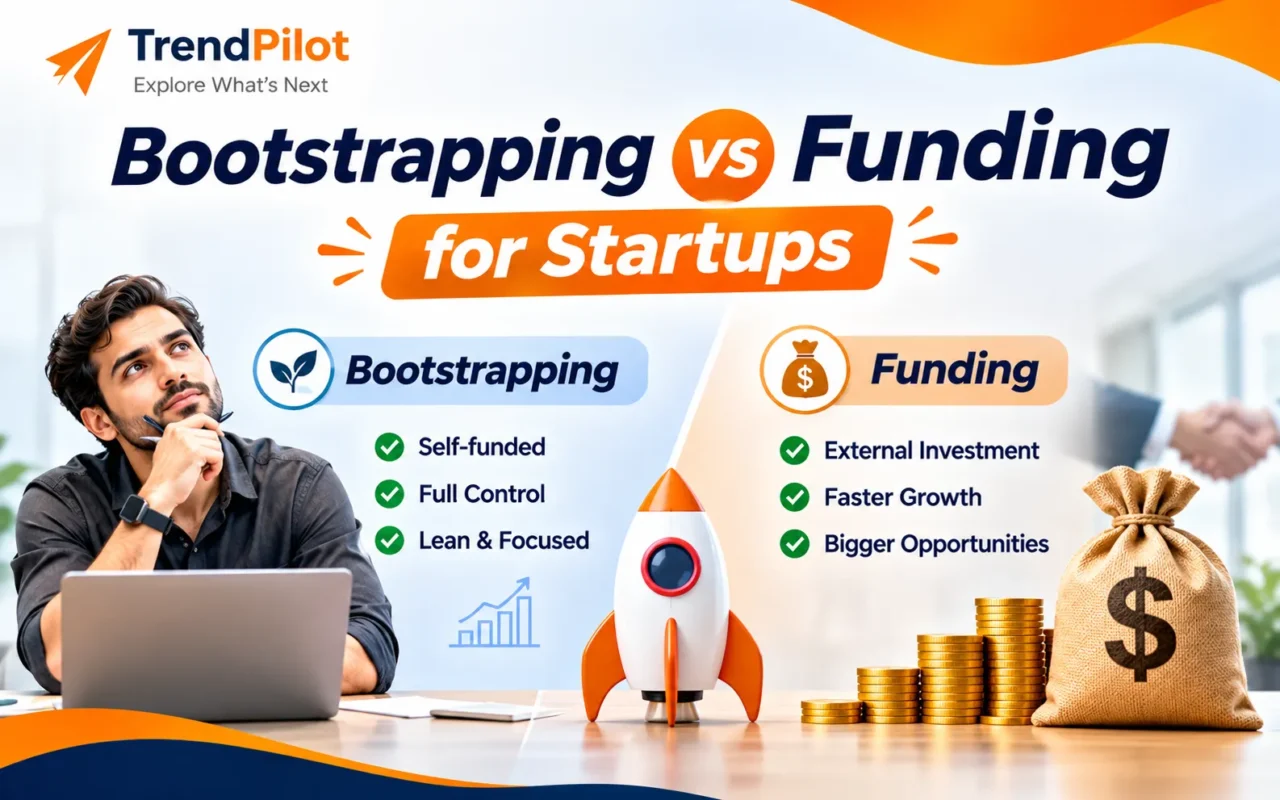
Bootstrapping is the process of starting and growing a business using personal savings, money from early customers, or revenue generated by the business instead of depending on external investors.
In simple words, you use the resources you already have to build your company.
For example, imagine an entrepreneur wants to start a digital marketing agency. Instead of borrowing money or approaching investors, they begin working from home, use affordable software, and find their first few clients.
As the business earns money, they reinvest a portion of the revenue into better tools, marketing, and hiring.
Advantages of Bootstrapping
Bootstrapping offers several benefits, especially for entrepreneurs who want to maintain control over their businesses.
1. Full Ownership and Control
One of the biggest advantages is that founders usually retain ownership of their company. They do not need to give away shares to outside investors.
2. Better Financial Discipline
When you work with limited resources, you learn to manage expenses carefully. You focus on necessary investments instead of spending money on things that do not directly support business growth.
3. Freedom to Make Decisions
Founders can make business decisions according to their own goals and customer requirements without meeting investor expectations.
4. Focus on Profitability
Since there is no large investment available, businesses need to generate revenue and manage cash flow carefully. This encourages founders to build a sustainable business model.
Disadvantages of Bootstrapping
Although bootstrapping provides independence, it also comes with certain limitations.
- Limited Resources: You may not have enough money to hire experienced employees, purchase advanced tools, or expand quickly.
- Slower Growth: Growing with limited capital can take more time, especially in competitive industries.
- Personal Financial Risk: Using personal savings can affect your financial stability if the business does not perform well.
- Increased Responsibility: Founders may need to manage multiple business activities because they cannot afford a large team.
Therefore, bootstrapping works best when founders can manage their initial expenses and generate revenue without requiring significant investment.
What Is Startup Funding?
Startup funding refers to the money a business receives from external sources to develop products, hire employees, improve operations, and expand its market presence.
Unlike bootstrapping, funding allows entrepreneurs to access additional financial resources without depending entirely on their own savings.
For example, a technology startup may need significant capital to develop an application, hire developers, build infrastructure, and promote its product.
Instead of waiting for business revenue, the founder may approach angel investors or venture capital firms to raise money.
Advantages of Startup Funding
1. Faster Business Growth
External investment can help startups enter new markets, launch products, and increase their customer base more quickly.
2. Access to Experienced Investors
Some investors provide more than money. They may also offer industry knowledge, business guidance, and useful professional connections.
3. Better Hiring Opportunities
With additional capital, startups can hire skilled employees and build teams for different business operations.
4. More Resources for Expansion
Funding can support product development, technology, marketing, research, and other important activities.
Disadvantages of Startup Funding
External investment can also create challenges for founders.
- Ownership Dilution: Equity investors receive a percentage of the company in exchange for their investment.
- Investor Expectations: Investors may expect specific growth targets and business results.
- Reduced Decision-Making Freedom: Some investors participate in important company decisions.
- Time-Consuming Process: Preparing documents, meeting investors, and completing due diligence can take considerable time.
As a result, founders should understand the investment terms before accepting external funding.
Bootstrapping vs Funding: Key Differences
Understanding the difference between these approaches can help entrepreneurs make better financial decisions.
| Comparison | Bootstrapping | External Funding |
| Source of money | Personal savings and business revenue | Investors, loans, and other external sources |
| Ownership | Founders generally retain ownership | Equity may be shared with investors |
| Growth speed | Often gradual | Can support faster expansion |
| Financial control | Greater control over spending | Depends on funding terms |
| Financial risk | More responsibility on founders | Risk depends on the funding structure |
| Decision-making | Mostly controlled by founders | Investors may have a role |
| Resources | Usually limited initially | Additional resources may be available |
Neither approach is automatically better. The right choice depends on your business model, financial requirements, growth plans, and ability to manage risk.
What Are the Best Startup Funding Options?
If your business requires additional capital, there are several startup funding options worth exploring.
Each option has different requirements, benefits, and responsibilities.
1. Angel Investors
Angel investors are individuals who invest their personal money in early-stage businesses in exchange for company ownership or equity.
They may also provide mentorship and industry connections.
This option can be useful for startups that have a promising idea, a clear business plan, and the potential to attract customers.
2. Venture Capital
Venture capital is a type of investment provided by professionally managed investment firms.
These firms usually invest in startups with strong growth potential.
For example, a technology company developing a scalable software product may approach venture capital firms to raise money for product development and expansion.
However, venture capital generally involves giving investors an ownership stake and meeting growth expectations.
3. Bank Loans
Business loans allow entrepreneurs to borrow money from banks or financial institutions.
Unlike equity investment, loans generally do not require founders to give away company ownership.
However, the borrowed amount must be repaid with interest according to the agreed terms.
Therefore, businesses should carefully evaluate their repayment capacity before choosing this option.
4. Government Startup Schemes
Government initiatives can provide financial support to eligible startups through grants, loans, or other funding programmes.
In India, entrepreneurs can explore resources available through the Startup India official portal.
The Startup India Seed Fund Scheme is one initiative designed to support eligible startups with activities such as proof of concept, prototype development, product trials, and market entry.
However, eligibility conditions and application requirements apply.
5. Crowdfunding
Crowdfunding involves collecting smaller contributions from a large number of people through online platforms.
It can help entrepreneurs test public interest in a product while raising money.
For example, a startup developing an innovative consumer product may present its idea online and invite interested people to support its development.
However, successful crowdfunding requires a clear product idea, audience trust, and effective promotion.
6. Friends and Family
Some founders receive initial financial support from friends or family members.
This can help entrepreneurs start operations without immediately approaching professional investors.
However, financial expectations and repayment or ownership terms should always be discussed clearly to avoid misunderstandings.
When Should a Startup Choose Bootstrapping?
Bootstrapping can be a suitable approach when your business does not require a large initial investment.
Consider this approach if:
- You can start your business with existing resources.
- Your initial operating costs are manageable.
- You can generate revenue from your first customers.
- You want to maintain ownership and decision-making control.
- Your business can grow gradually without large capital requirements.
For example, a freelance agency, consulting service, or small digital business may be able to start with basic tools and a small customer base.
If you are exploring a low-budget business idea, read our guide on How to Start an AI Startup With a Small Budget.
When Should a Startup Consider External Funding?
External funding may be more suitable when your business requires significant investment to develop or grow.
Consider exploring funding when:
- Your product requires expensive research or development.
- You need to hire a specialised team.
- Your business has strong customer demand but limited resources.
- You want to expand into multiple markets.
- Your competitors are growing faster because they have better access to capital.
However, raising money should not be the first goal of every startup. Founders should understand exactly how much money they need and how they plan to use it.
The Startup India funding guide provides useful information about funding sources and different stages of startup development.
Can Startups Combine Bootstrapping and Funding?
Yes. Many entrepreneurs consider a combination of both approaches instead of choosing only one.
A startup can begin with personal savings, develop an initial product, and acquire its first customers. Once the business demonstrates market demand, the founders can approach investors for additional capital.
This approach offers several benefits:
- Founders can test their ideas before raising money.
- Early customer feedback helps improve the product.
- Initial revenue can reduce dependence on investors.
- A proven business model can make funding discussions more meaningful.
For example, an entrepreneur may initially launch an online store using personal savings. After generating consistent sales, they may seek investment to improve inventory, marketing, and operations.
If you are planning an online business, explore our guide on Shopify vs WooCommerce to understand different e-commerce platforms.
5 Important Things to Consider Before Choosing a Funding Strategy
Before deciding between bootstrapping and external funding, evaluate these five factors.
1. Understand Your Business Requirements
Calculate how much money you actually need to start and operate your business.
2. Evaluate Your Financial Position
Understand your available savings, monthly expenses, and ability to manage financial risks.
3. Study Your Market
Research your competitors, target customers, industry demand, and growth opportunities.
4. Calculate the Cost of Funding
If you choose a loan, consider interest and repayment obligations. If you choose equity investment, understand how much ownership you may need to share.
5. Think About Long-Term Goals
Decide whether you want to build a small, profitable business or pursue rapid expansion into larger markets.
A clear understanding of these factors can help you choose a suitable financial strategy.
Conclusion: Bootstrapping vs Funding – Which Is Better?
The decision between bootstrapping vs funding depends on your startup’s requirements and long-term vision.
Bootstrapping offers greater ownership, financial discipline, and independence. However, it may limit how quickly your business can grow.
On the other hand, external funding provides additional capital, business connections, and opportunities for faster expansion. However, it may involve sharing ownership and accepting investor expectations.
For many entrepreneurs, starting small, validating the business idea, and raising money when necessary can be a practical approach.
Remember, successful business growth is not only about how much money you raise. It is also about how effectively you use your resources, understand your customers, and build a sustainable business.
Explore more practical insights, business ideas, and startup guides on The Trend Pilot and take your next step towards building a successful business.
Frequently Asked Questions (FAQs)
1. What is the main difference between bootstrapping and funding?
Bootstrapping means building a business using personal savings and business revenue, while external funding involves receiving money from investors, lenders, or other outside sources.
2. Is bootstrapping better than startup funding?
Neither option is always better. Bootstrapping offers more ownership and control, while funding can provide additional resources for faster growth.
3. Can a startup grow without investors?
Yes. A startup can grow without investors by using personal savings, generating revenue, controlling expenses, and reinvesting profits into business operations.
4. What are the most common startup funding options?
Common startup funding options include angel investors, venture capital, bank loans, government schemes, crowdfunding, and support from friends and family.
5. Do startups have to give away ownership when raising funds?
Not always. Equity investment involves sharing ownership, but loans and certain grants generally do not require founders to give away company shares.
6. Can a startup switch from bootstrapping to funding?
Yes. A startup can begin with personal resources and later raise external investment when it needs additional capital for product development, hiring, or expansion.
7. Which funding approach is suitable for small businesses?
Bootstrapping can be suitable for businesses with low initial costs and the ability to generate revenue early. However, the right approach depends on the business model and financial requirements.